Thursday, August 23, 2007

Strategic Innovators (India) runs Injo Essay


The essay "PR and the Innovation Communication System" by Nordfors (INJO-3-5) has been selected for publication by "Strategic Innovators" ( July - Sept 2007, Volume I | Issue 3), a quarterly Indian refereed journal on contemporary strategic management trends.

The essay printed in "Strategic Innovators" is available here in pdf:
strategic%20innovators%20nordfors.pdf

"Strategic Innovators" is published by The IIPM Think Tank, an independent, India-centric research body, is inspired by Dr. M.K. Chaudhuri's vision of India as an economic powerhouse in the 21st century. The IIPM Think Tank is committed to enhance public awareness of policy issues an economics and management and to engineer solutions that will fulfill the 'Great India Dream'. By publishing the finding of its research, and though the active participation of its senior researchers in the media and policy, it aims to bring new knowledge to the attention of policy makers.

Wednesday, August 15, 2007

Enterprise Estonia Injo page


Enterprise Estonia has published a page on Innovation Journalism, summarizing their activities in the field. The page is authored by Ene Kull, who is working on introducing the concept of innovation journalism in the Estonian innovation ecnomy. Enterprise Estonia is the national Estonian agency for innovation and entrepreneurship. Ene's Estonian Injo page is available here.

Eesti Pävalehti (Estonia) story on InJo


The Estonian journalist Tiit Kändler has published a story on the EJC Innovation Journalism Conference in the Estonian news outlet Eesti Päevaleht, including some comments about yours truly. PDF-version available here:
eesti%20injo%20070801.pdf

Tuesday, August 07, 2007

EJC to arrange more Injo conferences

Here is the executive summary of the conference "Innovation Journalism - Detecting Weak Signals". (originally posted by European Journalism Center - EJC who also have a comprehensive summary )

I want to thank the EJC for putting together a smashing three days at their headquarters in Maastricht. Under the helm of their visionary director, German broadcast veteran Wilfried Rütten, the EJC team brought together a very interesting group of people, maintaining interesting discussions around the clock for three days. It is great news that the EJC has decided to organize a second conference on Innovation Journalism, in 2008. Here is the summary in their words:

The tune of society’s conversation with itself sounds increasingly like punk rock music, said Stanford University researcher David Nordfors at the European Journalism Centre’s three-day conference on innovation journalism. Nordfors, who coined the phrase ‘innovation journalism’ in 2003, heads the Innovation Journalism program at Stanford, run by SCIL and VINNOVA.

To Nordfors, mainstream media today comes off a bit like a commercial rock band such as Led Zeppelin. And to the common man sitting way back in the cheap seats, such rock legends look and sound a bit out of focus.

More fun and accessible to the everyman are local punk bands, the indie groups rocking out in local public houses, he said. They are closer to real life, and much more direct in their message. And they don`t need big trucks for lighting and sound equipment to get their message across, thus making the point that everybody can “perform” if they have something vital to say. When “punk” first cropped up in the late seventies, many saw this as a paradigm change that turned music into a more democratic endeavor, away from big corporations and big money.

Innovation journalism, as Nordfors presented it at the July conference, is concerned with the paradigm changes of today, stressing the importance of technological innovations and addressing the necessity of media coverage of these developments. Innovation and innovation reporting are seen as catalysts for social transformations, tools by which innovations will become more readily disseminated across society.

For many present-day journalists working at traditional media outlets – and the concerned publishers eyeing their account ledgers – the idea of this a shift remains terrifying.

“A lot of journalists feel threatened within their traditional structures,” said Wilfried Rutten, director of the EJC.

More than 20 media experts from around Europe and the United States convened in Maastricht, the Netherlands, to discuss innovation journalism and the innovation ecosystem. The EJC partnered with the Amsterdam-Maastricht Summer University, Stanford and Deutche Welle to host the conference.

Most of the speakers, like Evgeny Morozov, the director of new media for Transitions Online, used their presentations to point out innovative developments in new media.

Morozov argued for the wisdom of the crowds, endorsing a bottom-up innovation process stemming from the diverse knowledge distributed among a growing number of people who are socially networking across the so-called blogosphere. Individual experts producing blogs, and the masses using use platforms such as Facebook, Flickr and YouTube, are further positive aspects of community.

“As technology gets smarter, paradoxically we see more and more emphasis put on the role of human interaction,” he noted.

Nordfors stressed the benefit of innovation in a democratic society and the need to understand the horizontal nature of innovation processes through innovation journalism, which treats innovation as a topic and follows its development across various wavelengths, be they technology, business, politics, etc.

In the vertically-structured newsrooms of today, it can be difficult to isolate the concept of innovation and add it as a buzzword to society’s daily dialogue.

Daniel Sokolov, a Vienna-based freelance journalist writing about tech and innovation news, advocated good, old-fashioned community involvement as a way to connect the dots of vertically-structured news beats. He pointed out the importance of talking about trends, trying to get a larger picture, crossing geographic borders. Journalists sometimes have an easier time spotting innovation in societies other than their own, he noted.

Sarah Schantin-Williams of IFRA Newsplex, a consulting group, pointed to several newsrooms, mainly the Daily Telegraph, which have recently reorganised in order to be more innovative. This reorganisation will allow them to be more up to date by focussing on a 24/7 updated news schedule the web allows. Moreover, by integrating more user comments, newspapers can widen their scope to be more inclusive of community aspects Also, by adding video, they are free to leave the narrow constraints of paper based information and can go for a richer and more engaging multimedia experience.

Newsrooms need to focus more on ideas and planning if they’re to produce multi-media packages, she said.

Deutsche Welle, the German broadcasting corporation that employs about 1,500 people from over 30 countries to produce programming in 30 languages, is trying to reach its audience on many platforms, said Wilfried Runde, the head of innovation projects.

Above all, Deutche Welle considers itself a content leader – not just a broadcaster, he said. Of increasing importance is considering how the DW product looks or sounds on various news aggregators and media players – be they iPods, mobile phones or laptop computers.

Stefan Jenzowsky, a Berlin-based marketing consultant formerly of Siemens, and Manfred Moormann, head of broadband entertainment and services at Telekom Austria, represented the telekom industries.

Jenzowsky drew inspiration from both Ron Hammer and the U.S. steel industry.
Mainstream media integrating new media into existing coverages can provide a platform for community, convergence and entertainment – a la Ron Hammer.
Mainstream media outlets need to integrate existing new media technologies into their coverages because integration provides, for any business, an insurance policy for the survival of the company, he said.

“Shares are traded on the assumption of the future performance of that company,”Jenzowsky said after chronicling the manner in which mini mills were able to become successful in the American steel market.
Moormann, who is best known for creating a platform for user-generated content in Engerwitzdorf, Austira, said that to him, innovation is foremost about finding economic applications for inventions. Inventions must have impact – like that of YouTube – if they are to be considered innovation.

Nearly all presenters lamented the lack of a business model mainstream media companies can employ in order to adapt to and be profitable in the innovation ecosystem.

Roland Strauss, a founder of the European Innovation Dialogue, said the image of innovation itself needs a makeover.

“Those who deal with it say innovation is the most important thing for our future – but the citizens don’t care,” he said.

The Mission of the EID – one of many groups trying to create networks of regional-level innovators in the interest of bringing their products or concepts to the EU level – is to be a one-stop shop for innovation – so key to achieving the goals laid out in the Lisbon Strategy of 2000. He spoke with great hope about developments in the works, such as the European Institute of Technology, a European answer to MIT.

Laws governing new media can seem at times about as clear as mud – and the lawyers and lawmakers the proverbial sticks in that mud. Michael Kams, an attorney from Hasche Sigle, and Eric Karstens, an expert in media regulation in the EU, held forth on legal constraints on innovation. Developing laws and policies which can roll with the times won’t be easy, both noted – but it is possible.

Most of the participants of the three-day conference in Maastricht, the Netherlands, came away with a positive view of innovation, EJC director Wilfried Rütten surmised.

He said that the EJC is likely to hold another innovation conference next year. A date has tentatively been set for early September.

Friday, July 27, 2007

Innovation Journalism Conference in Maastricht

Here is the documentary website of the INJO event in Maastricht, "Innovation Journalism: Detecting Weak Signals" organised by the European Journalism Center and Amsterdam Maastricht Summer University in collaboration with the Injo program at Stanford and Deutsche Welle.

Speakers at the event (in random order): Wilfried Rütten, Director, European Journalism Centre, Maastricht, David Nordfors, Stanford Center for Innovations in Learning, John Burke, World Association of Newspapers, Sarah Schantin-Williams, IFRA Newsplex, Jan Bierhoff, Director, European Centre for Digital Communication, Wilfried Runde, Head of Innovation Projects, Deutsche Welle, Marian Semm, IBM, Jörg Sadrozinski, Tagesschau Online, Stefan A. Jenzowsky, Trommsdorff + Drüner, Innovation + Marketing Consultants, Berlin. Former Vice President, Strate and Head of Business Innovation Siemens Communications, Manfred Moormann, Head of Broadband Entertainment and Services, Telekom Austria, Ekkehart Gerlach, Managing Director, Deutsche Medienakademie, Roland Strauss , European Innovation Dialogue, Strauss & Partners, Michael Kamps, CMS Hasche Sigle, Eric Karstens, European Journalism Centre, Daniel A.J. Sokolov, Journalist, Vienna, Evgeny Morozov , Director of New Media, Transitions Online, Prague

The EJC event site contains the program, summaries of talks and discussions, photos, videos etc, including the interview posted here below:

Thursday, July 26, 2007

European Journalism Center - Injo Conference Press Release

Press release by EJC
Innovation Journalism: Detecting Weak Signals
Maastricht - 20 July 2007

The European Journalism Centre will from 25-27 July at Avenue Ceramique 50 host a group of media experts from Europe and the United States at its seminar, “Innovation Journalism: Detecting Weak Signals.”

“Innovation Journalism” is a major new concept shaping the future of the media landscape. It stresses the importance of technological innovations and addresses the necessity of better media coverage of these developments. Innovation and innovation reporting are seen by many as significant catalysts for social transformations. Innovation journalism can be a tool by which innovations will become more readily disseminated across society.

The conference will assess the impact of the early signals from the realm of innovation journalism and will look at the impact different actors in the innovation space can have on developments. It will also discuss the new ways in which information is now being generated and distributed by citizens and journalists alike.

The EJC has partnered with the Amsterdam-Maastricht Summer University, Stanford University and Deutsche Welle to bring about 15 industry experts to Maastricht for this three-day conference. Stanford’s David Nordfors, a pioneer of the concept of innovation journalism, will open the conference when he delivers the keynote speech at 3 p.m. Thursday.

The seminar will address in particular innovation developments within the European Union, seeking to identify what can be learned from both winners and losers in the innovation space. Discussions will also be held on integrating innovation into working newsrooms.

Speakers will include: Claude Erbsen of “Innovation Media Consulting”; Wilfried Runde, head of innovation projects at Deutsche Welle; John Burke of the World Editors Forum; Roland Strauss of the European Innovation Dialogue with Strauss & Partners; Rufus Pollock of Cambridge University; Marian Semm, a senior consultant for media and entertainment publishing at IBM; Manfred Moormann, the head of broadband services for Telekom Austria as well as speakers from Ernst&Young and KPMG.

To download the complete programme, click here.

Monday, June 25, 2007

Injo Conference in Slovenia


The documentation from the regional European Injo conference in Slovenia is now available online.

The conference was very well arranged and successful. It was attended by top people from all parts of the Slovenian innovation system, including influential journalists, business people, academics and politicians, not least the EU commissioner for Science and Research, Janez Potocnik, who's speech at this event is available in the conference documentation and here.

The first Slovenian innovation journalism awards were presented at the event. Apart from those earlier presented on this blog, the big news was "The Golden Pen", which supports participation of a Slovenian journalist in the international Innovation Journalism Fellowship Program 2008. The prize is funded by the foundation Ad Futura.

The conference included presentations of the Slovenian innovation journalism projects funded by the Slovenian technology agency TIA, including some very stimulating work by Slovenian school children, who reported on innovation processes in their local community.

I was fortunate to be able to participate in the conference together with my colleague Jan Sandred, Injo Fellow 2004, now with the Injo program at VINNOVA in Sweden.

The conference was organized by Vibacom, headed by Violeta Bulc (picture).

Sunday, June 17, 2007

EU Commissioner Potocnik: EU Needs Innovation Journalism


Here is a video of the EU Commissioner for Science and Research, Janez Potocnik, delivering a speech in favor of the concept of innovation journalism. The transcript is here as a web page, and here as a pdf: Potocnik-injo-speech-14June2007.pdf

The speech was made on thursday June 14 at the regional innovation journalism conference in Ljubljana, Slovenia. The conference, a part of the Slovenian innovation journalism initiative, was arranged by Vibacom, the company founded by Violeta Bulc, who is spearheading the introduction of the injo concept in Slovenia.

As Potocnik refers to in his speech, in February I had the pleasure of a one-on-one with him in Brussels. Violeta and John Hagard, Swedish ambassador to Slovenia, had raised his interest in injo, leading up to an invitation to me to go to Brussels and tell him more about it.

Why should he be interested? As society becomes more innovative, it makes sense that it becomes more important to communicate how knowledge becomes valuable for people.

Another reason for interest is concern: Europe is losing competitiveness in the global innovation economy. Here is a BBC story on it from a few days ago, including quotes by Potocnik. The Lisbon Agenda from March 2000 aims at making the European Union (EU) the most competitive economy in the world and achieving full employment by 2010, i.e. within less than four years from now. Innovation is the key component of it. But in January 2006, former Finnish PM Esko Aho presented the EU "Aho Group Report", sounding the alarm bell, saying that Europe is not on track.

In unusually straight language, the Aho report pointed at a large gap between political rhetoric about the knowledge society and the reality of budgetary and other priorities. It urged Europe’s leaders to take radical action on research and innovation "before it is too late".

Here is where Injo comes in: (check out the earlier post on this blog: Injo Elevator Pitch - Why Democracies Should Care). For a democratic society to focus on the innovation economy, independent journalism needs to cover it. But news rooms are usually organized as traditional production line organizations, where each news beat is a separate line. Innovation crosses the traditional news beats (tech, business, politics, culture news), and is therefore a difficult for traditional news organisations to cover. So even though innovation is the leading driver of economic growth, it will be under-represented in the news. This is a strong reason to why the stumbling progress of the Lisbon Agenda has not reached the broader public discussion in the EU. Everything looks fine on the surface in European society, while it is slowly loosing its edge.

Good independent innovation journalism could make it possible for EU citizens to discuss their competitiveness in the world economy, and enable the democratic processes in the EU to address the issue.

Sunday, June 10, 2007

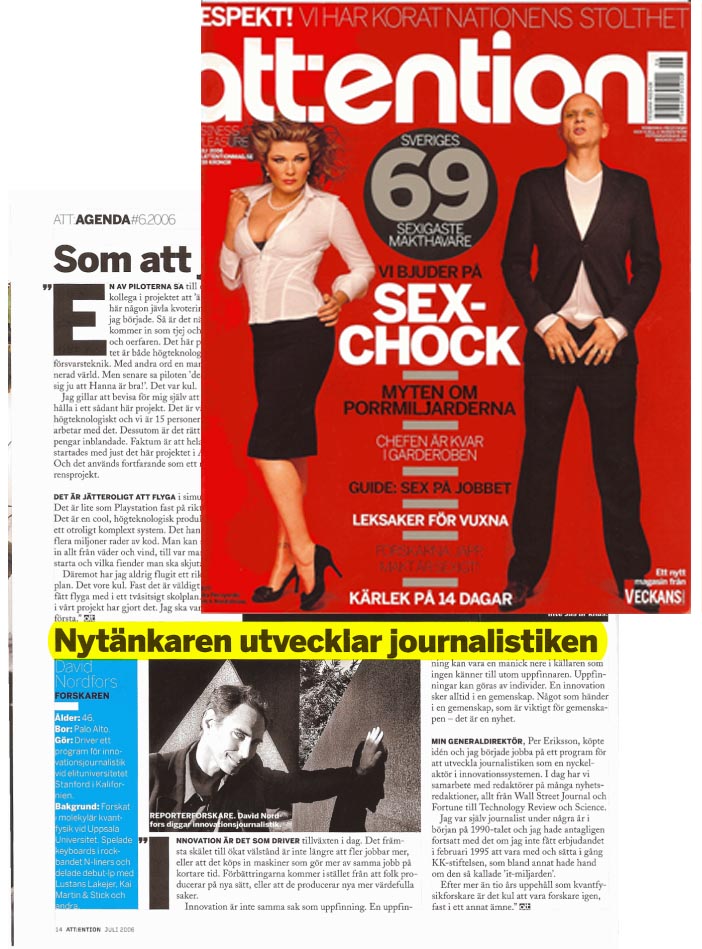
Interview in Att:ention


The Swedish magazine "Att:ention" published an interview with me on Innovation Journalism July 2006. The piece is written by Johan Jörgensen and Olle Corneer. Although a bit dated, I am posting it to the blog in order to make it available for reference. Att:ention is a monthly magazine made by Veckans Affärer, published by Bonniers Publishing house. Veckans Affärer is the largest Swedish business weekly.

Here is a PDF copy of the interview in the paper magazine: Attention%20interview.pdf

Translation in English:

The Visionary Modernizes Journalism
David Nordfors / The Researcher / Lives in: Palo Alto / Occupation: Runs a program in innovation journalism at the elite university Stanford in California / Background: Has done research in molecular quantum physics at Uppsala University [in Sweden]. Played keyboards in the rock band N-Liners and shared debut LP with Lustans Lakejer, Kaj Martin & Stick and others.

“It is innovation that is driving the economic growth today. The main reason for increased societal wealth is no longer that more people work more, or that machines are purchased in order to do more of the same work in shorter time. The improvements come instead from new ways for people to be productive, or that they produce new and more valuable things.
Innovation is not the same thing as invention. An invention can be a contraption in a cellar, known by nobody else than the inventor. Inventions can be made by individuals. An innovation always happens in a community. Something that happens in a community, something that is important for the community – that makes news.
My director general [at VINNOVA] Per Eriksson bought the idea and I started to work on a program to develop journalism as a key actor in innovation systems. Today we have collaboration with editors of many news rooms, spanning from Wall Street Journal and Fortune to Technology Review and Science.
I was myself a journalist for some years at the beginning of the 90s and had probably continued, if not I had been offered in February 1995 to take part in setting up the Knowledge Foundation [in Swedish: KK-stiftelsen / transl.] that, among other things, took care of the so called “IT Billion” [the Knowledge Foundation was in charge of spending more than one billion crowns - approx 135 million USD – on spreading the use of IT in Sweden / transl.]
After more than ten years pause as quantum physicist it is fun to be researcher again, although in a different topic.” (ATT)

Friday, June 08, 2007

The First Slovenian Innovation Journalism Award


The first award for Slovenian Innovation Journalism will be handed out at the regional conference on Innovation Journalism in Slovenia on June 14. Nataša Koražija from Manager Magazine is the winner in the main category, "the best journalistic contribution on innovations in Slovenian media in 2006". She will receive support to participate in the 5th Conference on innovation Journalism at Stanford University, California, USA in 2008 . The prize is sponsored by TIA, the National Slovenian Technology Agency.

Vesna Petkovšek from Gorenje gets the recognition for the "best contribution on innovations within Slovenian company magazines".

The following journalists will also receive recognitions for good work: Marjana Dremelj, Podjetnik; Primož Kaučič, Podjetnik; Sara Sonja Lunder, IRT3000; Matej Peternelj, Profit;
Samo Kranjec, Finance.

The awards are organized by Vibacom, headed by Slovenian entrepreneur Violeta Bulc, who has spearheaded the Slovenian Innovation Journalism initiative.

More information about the Slovenian awards here.

Tuesday, June 05, 2007

NDTV Profit (India) Interview


When visiting the CII/NAS First Global Summit on Innovation in India in the end of March NDTV Profit ran an interview with me.

NDTV is India's first and largest private producer of current affairs, sports and entertainment television. NDTV Profit, a 24-hour business plus channel, is India’s number one business news channel. For more information: www.ndtv.com

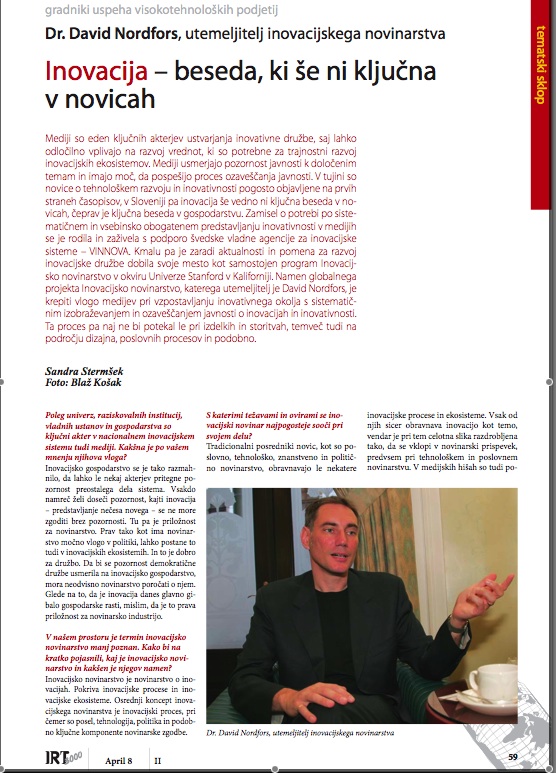
IRT3000 Story on Injo


The Slovenian magazine IRT3000 recently published an interview with me on innovation journalism. Here is a translation in English (does not include the introduction part).

A pdf with the IRT3000 story is available for download:
IRT3000%20interview%202007.pdf