For a democratic society to focus on the innovation economy, independent journalism needs to cover it. So journalism is an important independent actor in innovation ecosystems. But news rooms are usually organized as traditional production line organizations, where each news beat is a separate line. Innovation crosses the traditional news beats (tech, business, politics, culture news), and is therefore a difficult for traditional news organisations to cover. So even though innovation is the leading driver of economic growth, it will be under-represented in the news. The InJo program is trying to do something about this.
Here in powerpoint
Friday, February 09, 2007


Thursday, January 25, 2007
The Fourth Conference on Innovation Journalism Has Been Announced
JOURNALISM DRIVING INNOVATION.
INNOVATION DRIVING JOURNALISM.
This is the theme of The Fourth Conference on Innovation Journalism, which will be held at Stanford University May 21-23 this year.
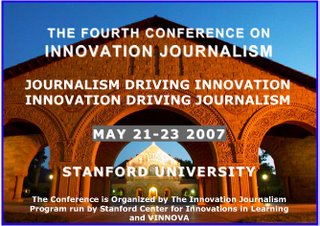 The Fourth Conference on Innovation Journalism is a gathering for professionals to discuss the interaction between journalism and innovation, including how innovation is changing the profession and business of journalism, how to cover innovation in the news, and how journalism links innovation with society. Target participants for the conference include journalists, professionals connected to the media/communications industry, innovation experts, students, and researchers.
The aim of the conference is to improve the understanding of how journalism and innovation drive each other, and to identify the key components of innovation journalism. This will involve looking at the innovation ecosystem as a playing field for journalism and choosing strategies that will allow media outlets to deliver quality news using the latest technology and to thrive in a competitive marketplace.
For more information or to register for the event, go to the conference website.
There is also information for those who are intrested in making a contribution to the conference.
INNOVATION DRIVING JOURNALISM.
This is the theme of The Fourth Conference on Innovation Journalism, which will be held at Stanford University May 21-23 this year.
The Fourth Conference on Innovation Journalism is a gathering for professionals to discuss the interaction between journalism and innovation, including how innovation is changing the profession and business of journalism, how to cover innovation in the news, and how journalism links innovation with society. Target participants for the conference include journalists, professionals connected to the media/communications industry, innovation experts, students, and researchers.The aim of the conference is to improve the understanding of how journalism and innovation drive each other, and to identify the key components of innovation journalism. This will involve looking at the innovation ecosystem as a playing field for journalism and choosing strategies that will allow media outlets to deliver quality news using the latest technology and to thrive in a competitive marketplace.
For more information or to register for the event, go to the conference website.
There is also information for those who are intrested in making a contribution to the conference.
Tuesday, January 23, 2007
Innovation Stories May Be Easier Done on Web than on Paper

Innovation Journalism is about mixing the traditional news beats. That may be more difficult to do on paper than on the web. Here is why:
The innovation story is nowadays rarely about tech OR business OR politics OR culture. It's increasingly about the mix of them. For those who need an example: Look first at the introduction of the music CD. Tech news reported on it in 1979. It was introduced to the market in 1982, and a few years later the business news could report on how it was taking over the market. That gave the news consumers the full story. Then look at what happened one decade later, when MP3-music got onto the Internet. This time the story was different - tech, business and culture were nested. Technology, business models, legal frameworks and culture are all interacting components of the story, and none of these components can reveal the story on their own. Which section should it be printed on in the newspaper? Tricky choice! It can only be printed in one news section, no one will print the same story in several places in the newspaper. Each section has a title and character of its own, like "business", "technology" or "culture", and is headed by an editor who is responsible for what goes in. Newsrooms are built for speed. News editors will have an easier life not overlapping each other. So many of them will drop important parts of a story in order to make it fit into their slot and not tread on any other editor's turf.
Ergo - news on paper offers a snug fit for a traditional line organization. The organization of the work force mirrors the structure of the newspaper. Each employee reports to one boss. And this usually means a bumpy and unsafe road for maverick writers attempting to cross the lines, trying to work with several bosses. Mixing tech, business, politics and culture - that can mean trouble for a writer!
The Web offers different circumstances than paper does. News sections are no longer physical spaces, they are tags. Each story can easily carry several tags, so there is no problem running the same story as "culture" and "business" and "tech" at the same time. There is no problem introducing multidisciplinary labels, like "innovation". Beats can overlap.
I am not saying that organizations doing news on the web can't be organized like paper newsrooms - many of them are. The point is: they don't have to! The crucial difference to paper news: News on the web does not inherently enforce a line organization with separated news beats.
Sunday, January 21, 2007
Journalism Now Subject to Moore's law

Using fossil fuel for distributing yesterdays news printed on dead trees will not remain a sustainable value proposition. We all know it, and the birth pangs of the new news industry can be felt all over the world. Established newspapers are changing owners like never before in modern times, the LA Times being the latest - but certainly not the last - monolith to go on the auction block.
The ad-based newspaper is a classic business model which has served society during the past two centuries with only minor changes. Printing and distribution technologies have improved, as have the tools used by journalists and marketers. But the basic principles have remained. So it is hardly surprising that large parts of the newspaper industry are unfamiliar with R&D departments and lack a true innovation culture. Something they will need more and more.
We can only speculate at this time how the new news industry will look like, but one thing we know for sure: any tool or solution introduced today will need to be replaced in a very short time. By going on the Internet, the news industry has become subject to Moore's law (things entering the market in two years time will have double the capacity of the stuff being released today).
Many newsrooms are bothered by introducing new tools and routines. They better start enjoying it, because as from now, as soon as they have made a change, they need start planning for changing it again.
The news industry is about to join the family of R&D-intensive innovation industries. Can the old news industry do it? Those who don't risk being toppled by the new kids on the block.


Monday, January 08, 2007
InJo on Slovenian Course Curriculum

Slovenia again. Violeta Bulc, the entrepreneur spearheading the introduction of the concept of innovation journalism in Slovenia, writes in her blog:
One more step in the manifestation and integration of the InJo concept. Yesterday I’ve started lecturing the »Innovation management« class at DOBA University. InJo found its place in the curriculum as an important tool for a successful manifestation of innovative society. Congratulation to the management of the school for advanced thinking and I will try my best to raise an appropriate interest for the subject with students, as well.
Finance [largest business daily in Slovenia. /David] are cool. They opened up their database (for a limited time only of course) for the students of Innovation Management class at DOBA University to allow a research on Innovation Journalism in Slovenian business press as part of required field work.
Thursday, January 04, 2007
Innovation in Journalism is Key

Throughout the three years we have been running the innovation journalism program, we have noticed how closely innovation journalism is related to innovative journalism, and how frequently they get mixed up with each other.
In theory, innovation journalism and innovation in journalism are not the same - one is about how to cover innovation in the news, the other is about new ways of doing journalism. But innovation in journalism gives leverage to innovation journalism, and may well be a condition for journalists understanding what it is.
Many newsrooms are extremely conservative environments, ruled by long-time traditions, where little innovation happens, and then only with great pains. But there are also innovative newsrooms, where new ideas are tested and implemented all the time. Probably a news organisation with a culture of innovation will have an easier time covering innovation issues in the news. Journalists will have better chances of understanding and reporting on the changes in the world around them, when these changes also occur in their own working environment. It can be challenging for a news room that rejects innovation in its own organisation to report on how ideas are transformed into new value in other organisations.
The Innovation Journalism program will be looking more into innovation in journalism. It is a topic of crucial interest for professional journalism today, there is an innovation ecosystem growing around it, and reporting on it is a good example of innovation journalism. Innovation in journalism is key for innovation journalism.
Friday, December 08, 2006
No Innovation Without Communication

I recently advocated that innovation journalism is key for innovation communication and PR to become an integrated part of the innovation process (here & here). Communication and journalism have a yin-yang-relationship that help drive each other, adding energy to what I call the "innovation communication system" - the flow of communication and attention of the innovation ecosystem. The innovation communication system is the key concept for the intersection between the innovation economy and the attention economy.
The concept of "Innovation Communication" was coined by Claudia Mast, Ansgar Zerfass and Simone Huck, in 2004, laying the foundation for looking at how organisations communicate innovation with their stakeholders. Their new INNOVATE report shows what can happen if communication is not a part of the innovation process from the start:
Making innovations known to their publics is a challenge that is underestimated by many. It is not sufficient to consult communication and marketing professionals during the late stages of the innovation process. At that time press releases and polished publications cannot create an understanding of intricate issues anymore.
UMTS, WAP and MMS have failed, partly because these three or four letter long abbreviations did not meet the customers’ and the journalists’ needs for explanation and exemplification.
Relating to existing trends and topics and illustrating the usefulness of the new services is a useful strategy, as well as reducing complexity and considering personal interests, concerns and the existing knowledge of journalists addressed. The name of “innovation” itself should not be mentioned too many times.
These are some findings of the INNOVATE 2006 project, a joint effort by MFG Baden-Württemberg – Agency for IT and Media (Stuttgart, Germany), and the Department of Communication Studies and Journalism at the University of Hohenheim (Stuttgart, Germany)
Monday, December 04, 2006
Criticism - always good to get
 (by Turo Uskali)
It is always valuable to get feed-back, and criticism. It keeps you awake and on the move, hopefully in the right direction. Colin Brayton criticized recently the innovation journalism initiative in his blog - the “virtual assignment desk”. Brayton, a journalist from Brooklyn, argues that the PR industry loves newspeak like "InJo" - the shorthand for "Innovation Journalism". Indeed, innovation itself is a word which is pretty positive in its nature. That is maybe why it is so popular among all the PR people as well as politicians. Usually, everyone is for innovations, not against them. Therefore, it is really important that journalists, like Brayton, and other intellectual language workers continuously monitor and pinpoint all the empty buzzwords, and try to replace them with better ones. Brayton wrote that the problem for a traditional journalist like he is “how to discover the pearls of true innovation in the flooded sump of newspeak that technology public relations has become.” That is what innovation journalism also tries to do, and, indeed, the task is not the easiest one.
Thursday, October 26, 2006
Dnevnik Introduces "Innovation" as Key Word for News

The second largest Slovenian daily, Dnevnik, has introduced "innovation" as a key word in their news archive search engine. They were given the idea by the Slovenian innovation journalism program. So as from now Slovenian news on innovation will be labeled with the key word "innovation". It might not seem very special, but it really is. Johan Boström, InJo Fellow 2005, looked into the issue - it is central and not easy looked Boström:"Innovation as a key word for news"). When the news agencies start using "innovation" as a key word, then it will be possible to subscribe to a newsfeed on innovation, and then it will be easier to make news sections on innovation.
PR and the Innovation Communication System

Here is an essay I wrote for PR people attending the 10th SKOJ conference in Slovenia.
The (non-academic) essay introduces the concept of the Innovation Communication System. The innovation system approach stresses that the innovation process is driven by the flow of technology and information between the actors in the innovation (eco)system. The innovation communication system approach suggests that the flow of attention is key to what gets done or gets dropped in the innovation system. There is a class of attention workers who are the key actors of the innovation communication system: journalists, PR & communication people, marketers, lobbyists, and others who have as they main job to create or broker attention. Intuitively, it is a quite well defined subsystem, as the attention workers very often interact between each other.
The main part of the essay pushes the point that public relations in innovation companies can strengthen brand value by communicating innovation processes and add value to innovation by developing narratives for new products and services in parallel with technological and business development. The development of innovation communication and PR will benefit from the emergence of independent innovation journalism. Such issues are being studied by the Innovation Communication group in Germany (see Ansgar Zerfass and Simone Huck, for example)
Tuesday, October 24, 2006
Roundtable: The Future of Innovation Journalism
It’s innovation time for journalism! Traditional news media are being challenged by innovative sources of news on the Internet, such as blogospheres, or citizen journalism. Traditional journalism struggles when covering innovation as a topic.
A roundtable discussion about the future of journalism with the
“Father of the Internet” Vint Cerf (Google /ICANN), Whitfield Diffie (SunMicrosystems), Amy Bernstein (Business 2.0), Lee Bruno (Red Herring), Dan Gillmor (Bayosphere), Anders Lotsson (Computer Sweden), Frances Mann-Craik (Tornado Insider, Addison Marketing), Harry McCracken (PC World), Tony Perkins (AlwayOn Network), Jan Sandred (Biotech Sweden), Richard Allan Horning (Tomlinson Zisko LLP), Charles Wessner (National Academies) and Stig Hagstrom (Stanford Center for Innovations in Learning). Producer and moderator: David Nordfors (Stanford / VINNOVA). Editor: Robert Emery Smith (Stanford), Recording Team Director: Mauricio Quijano (Stanford Video), Engineer: Gordon Gurley (Stanford Video), Cameras: Steve Schecter, Tamsin Orion, Mark Whelan (Stanford Video), PA: Austin Brizgys (Stanford Video), Text Editor: John Joss
Hardcopies of the DVD can be ordered from Amazon.com or VINNOVA
DVD, 120 minutes, All regions, UPC 837101387
Slovenian TV Runs Story on Innovation Journalism
News story from the Slovenian E+ TV show covering the First European Innovation Journalism Workshop at the University of Ljubljana, Slovenia, EU. The reportage is made by Maja Nemec and includes interviews with Marko Milosavljevic, Violeta Bulc and David Nordfors. It was broadcast by Kanal A on 20 Oct 2006.
Subscribe to:
Posts (Atom)

 Posts
Posts