Saturday, March 17, 2007

MSM vs Google: News Follows Music?

(this is a re-post of a blog post I originally published elsewhere on Mar 17 2007)

It was bound to happen – Viacom is suing Google for a billion dollars for hosting uploaded clips of their stuff on Youtube. The prelude occured only a few weeks ago, when a group of newspapers in Belgium won a court case in Brussels against the search giant, barring Google from re-publishing any snippets of their news on the search engine. Google is now in danger of becoming a main target for the struggling main stream media.

The news industry has been facing tough times for a several years now, and it is steadily getting worse, as Craig’s list and other web companies are taking over ads that have been the backbone of the news industry for over a century. The foundations of the fourth estate are shaking, well respected newspapers are downsizing or being sold off. No more Mr Nice Guy, as the saying goes, Hollywood-style. The victory in the Belgium court raises hopes among traditional media houses that pay-back time may be coming, and their lawyers are most probably sharpening their knives.

This can lead to a very very bad development for us all, I’ll tell you why.

A lot of people want your attention, but it’s limited. The more competition for your attention, the more it’s worth. The news industry are “attention workers”: they catch your attention on a page by putting catchy stories on it, then sell parts of the page to people who are willing to pay for getting your attention diverted to their own stories. That’s ads. It was working well for 150 years. Enter the Internet.

In the beginning, many in the news industry thought it was a good thing to be visible on Google search, because it directed attention to their news stories on the web. Google was a young company, smaller than the news giants. They decided to stay out of content production, perhaps they thought this would keep them away from competing with the news industry. But the news industry does not sell stories, they pay for stories. They sell ads. Google sells ads, too. Google is now earning better than the news industry.
OK, they are not direct competitors to the news industry. Instead they are rapidly becoming the “alien invasion”, and that is not necessarily a more favored status.

Tourist guides like kids to direct customers to them, and they don’t mind if the kids get some pennies from the tourists while doing it. Replace the kids with grownups, give them more contact with the tourists than the guides have, and let them earn more than the guides. Now the guides will be less happy, they might even feel exploited. This is what is happening between Google and the news industry.

The news industry is paying for making stories, but is having a tough time selling ads. Google is not paying for making stories, and is selling ads like crazy. “Foul play”, says the news industry. “The stories are ours. If you sell ads on links to our stories, the ad revenues are ours, too”. Now it has reached the court rooms, and the battle might be long and bitter, like with the music industry and the Internet.

That will be too bad, because there is a fundamental common interest between the news industry and Google that can bring them to the same side of the table: both want to maximize the value of your attention, because this is the source of their income. They are only lacking a way to work together on it, and don’t have a working way to split the costs and revenues.

The larger part of the news industry does not know how to earn big on the Internet. Most of them don’t have the resources, the mindset or the traditions to innovate. For them, news is a commodity, innovation is a threat. Google is all about innovation and Internet, and they are earning more money on it all the time. No big match there at this time.

The old fashioned news industry has lawyers. So does Google. Match! It’s a big risk it’s going to end up in the court rooms. Once the parties dig into the trenches, people on both sides will be restricted from working together on a constructive future. It will be war between the main stream news and the web, like it was with the music industry.

In order to spend human time and resources on building value, not destroying it, the following is required: The news industry needs to become innovative and find other business models than paper. It will both provide them with a future and will save scores of trees from the axe. Google needs to realize that they are the big guys now, and that they will be put to blame by the echelons of society for the demise of the business of journalism, whether it is reasonable or not. High class content is good for their business, why not see what they can do for supporting its existence?

There are two types of deals that Google and the news industry can focus on. The first type is a fictitious zero-sum game, with endless fights in court rooms over how to split the pie, where the deal might even be obsolete by the time it hits the street. The other type is where the parties agree to work together on finding new ways of doing pies, or even doing other things than pies that might taste even better.

Isn’t it obvious what the choice ought to be?

Friday, March 09, 2007

New concept: Innovation Requires New Words, Requires Journalism


By David Nordfors and Turo Uskali

When SRI President Curtis Carlson first heard about the concept of Innovation Journalism, he said injo is important, because it will establish a common language for discussing innovation processes. This makes it possible for society to discuss innovation.

Chuck House, Stanford Media-X executive director and former head of ACM, independently made a similar reflection: A reason to why HP back-then could spearhead innovation was that many of the engineers came from Stanford, sharing a unique set of vocabulary for describing electronics, which made it possible for them to efficiently communicate ideas with each other.

Language is at the core of innovation!

We suggest journalism is even more important in innovation societies than in traditional societies!

Here goes:
  1. Innovation is the introduction of something new
  2. In order to introduce something, it needs to be communicated
  3. Communication requires shared language
  4. New things need new words or word combinations to be a part of the language
  5. The News makes/spreads the new words to us so that the new things can be included in our language, discussed and introduced.
  6. Therefore: Journalism enables society to discuss new things and introduce innovations.

This applies for all journalism covering innovations.

Injo - journalism about innovation processes and ecosystems - is a special case, but a very important one. It disseminates language for discussing how innovation happens in society. So innovation journalism enables society to improve innovation processes, which can affect the rate of innovation even more than the journalism about the innovations themselves.

If you agree, and have a bit of an academic mind - here is the word to hook up with injo: neologism. "Neologism", according to the dictionary (Wikipedia), is "a word, term, or phrase which has been recently created ("coined") — often to apply to new concepts, to synthesize pre-existing concepts, or to make older terminology sound more contemporary. Neologisms are especially useful in identifying inventions, new phenomena, or old ideas which have taken on a new cultural context. The term e-mail, as used today, is an example of a neologism." It continues, "Neologisms often become popular by way of mass media, the Internet, or word of mouth (see also Wiktionary's Neologisms:unstable or Protologism pages for a wiki venue of popularizing newly coined words). Every word in a language was, at some time, a neologism, though most of these ceased to be such through time and acceptance."

So innovation journalism and neologism form together a new key concept.

We are presently preparing a paper, to be presented later this year, that will develop this concept further.

Sunday, March 04, 2007

InJo Fellowships 2007 Kickoff @ Stanford


Here are photo albums with pictures from the kickoff week with the Innovation Journalism Fellowship Program 2007 at Stanford.

Saturday, March 03, 2007

New InJo Book

(by David Nordfors and Turo Uskali)

Erkki Kauhanen and Elina Noppari at the University of Tampere have now released the results of their research on innovation journalism in Finland, a project that has been going on for two years with funding from Tekes, the national Finnish agency for technology and innovation.

The study is the largest single compilation to date of empirical research on innovation journalism, setting a benchmark for future research. This seminal Finnish research has more emphasis on social innovations than previous work. This is clearly its most important achievement, and contribution to innovation journalism research.

Erkki and Elina argue for a wider definition of the concept of innovation journalism than the orginal one (which they call "Nordforsian" InJo). The focus is not on the innovation ecosystem, rather on the future of society. We agree that more emphasis may have been put on social and cultural aspects in the original work, and it is definitely key for innovation journalism to be able to discuss the future. Still, it seems constructive to limit the definition of Innovation Journalism to journalism about innovation, covering innovation processes and ecosystems. Yes - all innovation affects the future and all innovation causes change, this is true. But not all change is innovation and not all of the future is set by it. So it does make sense to keep some distinction between innovation journalism and forward-looking journalism, and to journalism of change. InJo is a subset of these wider scopes. With this said, we are happy about this book and the discussion it raises.

The Finnish study points at important issues, such as that journalism covering innovation in Finland today does not present the future perspective very much. Another interesting finding is "the hyperdominance" of ICT themes among the technology innovation related topics at the cost of all other fields of technology. Furthermore, the emphasis of the stories are centered on Finnish perspectives on innovations, and not on the international dimensions of innovation processes. The study identifies several needs of improvement.

The report is available for download on the Finnish innovation journalism site and at Tekes official site.

Friday, February 09, 2007

InJo Elevator Pitch: Why Democracies Should Care

For a democratic society to focus on the innovation economy, independent journalism needs to cover it. So journalism is an important independent actor in innovation ecosystems. But news rooms are usually organized as traditional production line organizations, where each news beat is a separate line. Innovation crosses the traditional news beats (tech, business, politics, culture news), and is therefore a difficult for traditional news organisations to cover. So even though innovation is the leading driver of economic growth, it will be under-represented in the news. The InJo program is trying to do something about this.

Here in powerpoint

Thursday, January 25, 2007

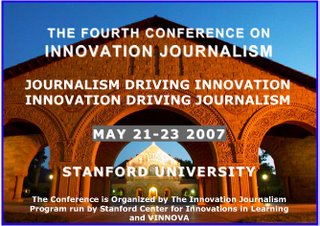
The Fourth Conference on Innovation Journalism Has Been Announced

JOURNALISM DRIVING INNOVATION.
INNOVATION DRIVING JOURNALISM.


This is the theme of The Fourth Conference on Innovation Journalism, which will be held at Stanford University May 21-23 this year.

The Fourth Conference on Innovation Journalism is a gathering for professionals to discuss the interaction between journalism and innovation, including how innovation is changing the profession and business of journalism, how to cover innovation in the news, and how journalism links innovation with society. Target participants for the conference include journalists, professionals connected to the media/communications industry, innovation experts, students, and researchers.

The aim of the conference is to improve the understanding of how journalism and innovation drive each other, and to identify the key components of innovation journalism. This will involve looking at the innovation ecosystem as a playing field for journalism and choosing strategies that will allow media outlets to deliver quality news using the latest technology and to thrive in a competitive marketplace.

For more information or to register for the event, go to the conference website.
There is also information for those who are intrested in making a contribution to the conference.

Tuesday, January 23, 2007

Innovation Stories May Be Easier Done on Web than on Paper


Innovation Journalism is about mixing the traditional news beats. That may be more difficult to do on paper than on the web. Here is why:

The innovation story is nowadays rarely about tech OR business OR politics OR culture. It's increasingly about the mix of them. For those who need an example: Look first at the introduction of the music CD. Tech news reported on it in 1979. It was introduced to the market in 1982, and a few years later the business news could report on how it was taking over the market. That gave the news consumers the full story. Then look at what happened one decade later, when MP3-music got onto the Internet. This time the story was different - tech, business and culture were nested. Technology, business models, legal frameworks and culture are all interacting components of the story, and none of these components can reveal the story on their own. Which section should it be printed on in the newspaper? Tricky choice! It can only be printed in one news section, no one will print the same story in several places in the newspaper. Each section has a title and character of its own, like "business", "technology" or "culture", and is headed by an editor who is responsible for what goes in. Newsrooms are built for speed. News editors will have an easier life not overlapping each other. So many of them will drop important parts of a story in order to make it fit into their slot and not tread on any other editor's turf.

Ergo - news on paper offers a snug fit for a traditional line organization. The organization of the work force mirrors the structure of the newspaper. Each employee reports to one boss. And this usually means a bumpy and unsafe road for maverick writers attempting to cross the lines, trying to work with several bosses. Mixing tech, business, politics and culture - that can mean trouble for a writer!

The Web offers different circumstances than paper does. News sections are no longer physical spaces, they are tags. Each story can easily carry several tags, so there is no problem running the same story as "culture" and "business" and "tech" at the same time. There is no problem introducing multidisciplinary labels, like "innovation". Beats can overlap.

I am not saying that organizations doing news on the web can't be organized like paper newsrooms - many of them are. The point is: they don't have to! The crucial difference to paper news: News on the web does not inherently enforce a line organization with separated news beats.

Sunday, January 21, 2007

Journalism Now Subject to Moore's law


Using fossil fuel for distributing yesterdays news printed on dead trees will not remain a sustainable value proposition. We all know it, and the birth pangs of the new news industry can be felt all over the world. Established newspapers are changing owners like never before in modern times, the LA Times being the latest - but certainly not the last - monolith to go on the auction block.

The ad-based newspaper is a classic business model which has served society during the past two centuries with only minor changes. Printing and distribution technologies have improved, as have the tools used by journalists and marketers. But the basic principles have remained. So it is hardly surprising that large parts of the newspaper industry are unfamiliar with R&D departments and lack a true innovation culture. Something they will need more and more.

We can only speculate at this time how the new news industry will look like, but one thing we know for sure: any tool or solution introduced today will need to be replaced in a very short time. By going on the Internet, the news industry has become subject to Moore's law (things entering the market in two years time will have double the capacity of the stuff being released today).

Many newsrooms are bothered by introducing new tools and routines. They better start enjoying it, because as from now, as soon as they have made a change, they need start planning for changing it again.

The news industry is about to join the family of R&D-intensive innovation industries. Can the old news industry do it? Those who don't risk being toppled by the new kids on the block.


Monday, January 08, 2007

InJo on Slovenian Course Curriculum


Slovenia again. Violeta Bulc, the entrepreneur spearheading the introduction of the concept of innovation journalism in Slovenia, writes in her blog:

One more step in the manifestation and integration of the InJo concept. Yesterday I’ve started lecturing the »Innovation management« class at DOBA University. InJo found its place in the curriculum as an important tool for a successful manifestation of innovative society. Congratulation to the management of the school for advanced thinking and I will try my best to raise an appropriate interest for the subject with students, as well.

Finance [largest business daily in Slovenia. /David] are cool. They opened up their database (for a limited time only of course) for the students of Innovation Management class at DOBA University to allow a research on Innovation Journalism in Slovenian business press as part of required field work.

Thursday, January 04, 2007

Innovation in Journalism is Key


Throughout the three years we have been running the innovation journalism program, we have noticed how closely innovation journalism is related to innovative journalism, and how frequently they get mixed up with each other.

In theory, innovation journalism and innovation in journalism are not the same - one is about how to cover innovation in the news, the other is about new ways of doing journalism. But innovation in journalism gives leverage to innovation journalism, and may well be a condition for journalists understanding what it is.

Many newsrooms are extremely conservative environments, ruled by long-time traditions, where little innovation happens, and then only with great pains. But there are also innovative newsrooms, where new ideas are tested and implemented all the time. Probably a news organisation with a culture of innovation will have an easier time covering innovation issues in the news. Journalists will have better chances of understanding and reporting on the changes in the world around them, when these changes also occur in their own working environment. It can be challenging for a news room that rejects innovation in its own organisation to report on how ideas are transformed into new value in other organisations.

The Innovation Journalism program will be looking more into innovation in journalism. It is a topic of crucial interest for professional journalism today, there is an innovation ecosystem growing around it, and reporting on it is a good example of innovation journalism. Innovation in journalism is key for innovation journalism.

Friday, December 08, 2006

No Innovation Without Communication


I recently advocated that innovation journalism is key for innovation communication and PR to become an integrated part of the innovation process (here & here). Communication and journalism have a yin-yang-relationship that help drive each other, adding energy to what I call the "innovation communication system" - the flow of communication and attention of the innovation ecosystem. The innovation communication system is the key concept for the intersection between the innovation economy and the attention economy.

The concept of "Innovation Communication" was coined by Claudia Mast, Ansgar Zerfass and Simone Huck, in 2004, laying the foundation for looking at how organisations communicate innovation with their stakeholders. Their new INNOVATE report shows what can happen if communication is not a part of the innovation process from the start:

Making innovations known to their publics is a challenge that is underestimated by many. It is not sufficient to consult communication and marketing professionals during the late stages of the innovation process. At that time press releases and polished publications cannot create an understanding of intricate issues anymore.
UMTS, WAP and MMS have failed, partly because these three or four letter long abbreviations did not meet the customers’ and the journalists’ needs for explanation and exemplification.
Relating to existing trends and topics and illustrating the usefulness of the new services is a useful strategy, as well as reducing complexity and considering personal interests, concerns and the existing knowledge of journalists addressed. The name of “innovation” itself should not be mentioned too many times.

These are some findings of the INNOVATE 2006 project, a joint effort by MFG Baden-Württemberg – Agency for IT and Media (Stuttgart, Germany), and the Department of Communication Studies and Journalism at the University of Hohenheim (Stuttgart, Germany)

Monday, December 04, 2006

Criticism - always good to get

(by Turo Uskali)

It is always valuable to get feed-back, and criticism. It keeps you awake and on the move, hopefully in the right direction. Colin Brayton criticized recently the innovation journalism initiative in his blog - the “virtual assignment desk”. Brayton, a journalist from Brooklyn, argues that the PR industry loves newspeak like "InJo" - the shorthand for "Innovation Journalism". Indeed, innovation itself is a word which is pretty positive in its nature. That is maybe why it is so popular among all the PR people as well as politicians. Usually, everyone is for innovations, not against them. Therefore, it is really important that journalists, like Brayton, and other intellectual language workers continuously monitor and pinpoint all the empty buzzwords, and try to replace them with better ones. Brayton wrote that the problem for a traditional journalist like he is “how to discover the pearls of true innovation in the flooded sump of newspeak that technology public relations has become.” That is what innovation journalism also tries to do, and, indeed, the task is not the easiest one.