Friday, September 10, 2010
Announcing IJ-8 May 23-25 2011. Academic Track Call for Papers
Wednesday, April 07, 2010
Slovenian Conference on Innovation Communication

Some great news from Slovenia (I added links):
On Apr 7, 2010, at 13:08, Violeta Bulc wrote:
Ok.. tomorrow is a big day ... Slovenian Conference on Innovation communication (one of the 4 tracks is innovation journalism).. we have 183 registered participants; we will also give away 27 awards in different categories for InJo for 2009. Rx, Violeta
ps; the new director of our the biggest daily newspaper (DELO) has mentioned yesterday in his speech that the restructuring of the newspaper will be based on innovation journalism principles, fresh approach and new technologies
Sunday, March 21, 2010
Examples of Flavors of InJo

Sunday, March 14, 2010
Nokia chairman delivers Finnish InJo prize
Finland is profiled as the world´s first country that implemented an Innovation Policy Program based on R&D and knowledge, as early as 1990. Finjo, founded three years ago, is another first; so far the only association in the world formally committed to Innovation Journalism, that is journalism about innovation and innovations in journalism. The word innovation is somewhat tainted by hype and rhetoric.
“I think it´s easier to get the message through if we talk about renewal processes or social change. I also believe that the deep recession Finland and parts of the world is in right now makes the issue more urgent and people more responsive. It’s a sort of Finland 2.0 discourse”, says Carl-Gustav Linden who is a business writer and researcher at University of Helsinki.
Finjo brings a broad variety of experts together –journalists, communication specialists, researchers, bureaucrats and business people for sharing thoughts on topics varying from the effects of social media to the R&D policy of the European Union. Openness is maybe one of the strongest assets of Finland and the rest of the Nordic countries, where Linux and MySQL are just two examples of where open and voluntary collaboration can lead.
“Even though Finland has been ahead of the rest in forming innovation policy there is a need for politicization and democratization and I believe Finjo is be just the right venue for these discussions”, says Carl-Gustav Linden.
Thursday, February 11, 2010
IJ-7 Academic Track - Call For Papers
IJ-7 The Seventh Conference on Innovation Journalism
Stanford University, Stanford CA
June 7-9, 2010
IJ-7 The Seventh Conference on Innovation Journalism is a venue for researchers from many disciplines and institutions to present work and ideas relating to the interplay of journalism and other forms of communication in innovation ecosystems. IJ-7 is also a meeting place for researchers and journalism professionals to discuss the best ways of covering innovation in the news, the business of doing that work, and how innovation journalism interacts with society. The conference welcomes a varied set of participants: Working journalists, policy-makers in journalism and innovation, academic researchers, faculty and research students in related areas of commerce, communication and journalism, and other professionals connected to the media industry.
The Conference is hosted at Stanford University under the auspices of the Vinnova Stanford Research Center on Innovation Journalism. The Innovation Journalism Center welcomes faculty and graduate student submissions on all topics related to communication and innovation. The Program Committee specifically welcomes strong theoretical and empirical contributions without regard to particular methodological approach, professional context (including journalism, advertising, public relations, strategy and innovation, and the standard social science disciplines) and overall orientation of the research (theoretical, descriptive, philosophical, pedagogical, methodological or practical).
“The Prinjos” –The Prizes for Best Innovation Journalism Paper
The best papers in each of the following three categories will receive a recognition for “Best Paper at the Innovation Journalism Conference at Stanford 2010”:
1. The Grand Prinjo: best conference paper among all submissions.
2. The Junior Prinjo: best paper submitted by graduate students.
3. The Journalist Prinjo: best paper submitted by practitioners.
Manuscript Submission
Authors may submit paper proposals or full papers.
- Paper Proposal – 500-700 words. Open until April 1, 2010
- Full Paper – max 25 pages excluding bibliography and appendices. Open until June 1, 2010.
Please make the submission documents anonymous – author(s) identity must not be displayed. Please provide a separate page with paper title and an abstract of no more than 75 words; write name, affiliation and all contact information of the author(s) on that page with the abstract. Format should be Word, citations in Harvard Style. Paper and abstract must be sent as attachments in one email to
SUBMISSION OF PAPER PROPOSALS
If you want to test if your idea for a paper is welcomed by the Program Committee before undertaking the work of producing a paper, submit a paper proposal by April 1 and indicate that you would like to submit a complete paper. If our reviewers favor your proposal, you will receive an invitation to submit a paper before June 1. Your full paper will then be reviewed and given the status of either ‘reviewed paper’ or ‘paper in progress’ at the Conference.
SUBMISSION OF FULL PAPERS
You may submit a paper directly, without first submitting a proposal. Your paper may be accepted as a ‘reviewed paper’, ‘paper in progress’, or – if it does not meet the criteria of the conference – ‘rejected’. Please submit full papers to IJ7-mogensen@STANFORD.edu any time before June 1, 2010.
All papers will undergo blind peer review. The review process is humane, including reasonable turnaround time on submissions and firm but polite critique. Papers are reviewed in the order they are received and authors will receive answers as soon as the paper has been evaluated. Authors of accepted papers are expected to present their papers at the Innovation Journalism Conference at Stanford University. Authors of rejected full papers are invited to participate in the conference without presenting their work. No conference fee is collected.
.
Main themes of IJ-7 Academic Track:
· How journalism and innovation interact.
· How journalism can cover innovation processes and innovation ecosystems.
· Towards a systems view: Public attention and attention work in innovation communication ecosystems, the stakeholders and audiences, and the interaction between these elements.
Examples of research topics of interest:
· Professional norms, values, codes of ethics and principles of innovation journalism.
· How newsrooms and other professional organizations affect the coverage of innovation.
· Democracy and governance: The role of journalism in the innovation economy.
· Concept of attention work, the professional generation and brokering of attention.
· Concept of innovation communication systems; the flow of attention in innovation systems.
· How innovation processes and innovation ecosystems interact with public attention, with news media as an actor.
· Interdependencies between journalism and other actors in the innovation system.
· The roles of reputation and trust in the innovation ecosystem.
· Business Models for innovation journalism.
· Models of innovation and media, including firm, industry and economy-wide innovation systems.
· Governance, accountability and innovation in and by journalists and media actors.
· State of the art as well as theory and practice in the teaching of innovation journalism.
· Innovation journalism and feminism.
Information about the conference and accepted papers will be posted on:
http://www.innovationjournalism.org , the general InJo site, and the forthcoming conference sites
http://ij7.innovationjournalism.org alias http://ij7.stanford.edu
Program Committee
IJ-7 Chair: David Nordfors, Executive Director, VINNOVA-Stanford Research Center of Innovation Journalism.
IJ-7 Academic Track Chair: Kirsten Mogensen, Visiting InJo Researcher, Stanford University and Associate Professor, Roskilde University.
Turo Uskali, University of Jyväskylä, Finland and Senior Research Scholar. VINNOVA Stanford Center.
Marc Ventresca, University Lecturer in Strategy, Saïd Business School, University of Oxford; Senior Research Scholar, VINNOVA Stanford Center; and Research Faculty, Global Public Policy, Naval Postgraduate School
Doctoral Student Bettina Maisch, Institute for Media and Communication Management at University of St.Gallen andVisiting Researcher, Center for Design Research at Stanford
Program Committee Contact:
Professor Kirsten Mogensen: kirstenm@stanford.edu
Visiting Innovation Journalism Researcher
Vinnova-Stanford Research Center of Innovation Journalism, Stanford University.
Saturday, January 30, 2010
InJo TV Series Wins "Brand of the Year"

SAMAA TV in Pakistan embraced the Innovation Journalism journalism concept and started the series "INNOVATION" in 2009. That InJo series has now been awarded "Brand of the Year", beating +500 innovation brands from all industries, winning both the consumer vote and the expert panel ranking. It's the first time a journalistic product wins the award. On top of that, SAMAA won the Corporate Social Responsibility award, an achievement SAMAA says happened due to its InJo approach.
Congratulations to Amir Jahangir, CEO of SAMAA TV, Shahray Zariff, Executive Producer of the INNOVATION series, and Fatima Akhtar, anchor and team member of the show, who will be an InJo Fellow 2010 at Stanford.
SAMAA's success tells us some things:
1. INJO IS POPULAR JOURNALISM
2. INJO CAN BE CENTRAL IN INNOVATION SYSTEMS
3. INJO WORKS IN EMERGING ECONOMIES
The Stanford news release is here below, followed by the SAMAA release. Here is an introductory video of the award winning INNOVATION InJo TV series (in English):
STANFORD UNIVERSITY NEWS SERVICE
Jan 26 2010.
(Here is the news release on Stanford's news web. Here is a copy in PDF)
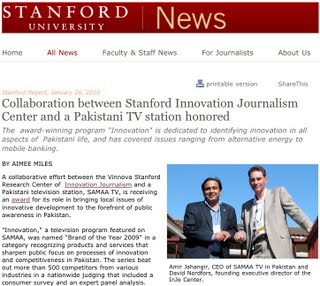
Collaboration between Stanford Innovation Journalism Center and a Pakistani TV station honored
The award-winning program "Innovation" is dedicated to identifying innovation in all aspects of Pakistani life, and has covered issues ranging from alternative energy to mobile banking.
BY AIMEE MILESA collaborative effort between the Vinnova Stanford Research Center of Innovation Journalism and a Pakistani television station, SAMAA TV, is receiving an award for its role in bringing local issues of innovative development to the forefront of public awareness in Pakistan.
"Innovation," a television program featured on SAMAA, was named "Brand of the Year 2009" in a category recognizing products and services that sharpen public focus on processes of innovation and competitiveness in Pakistan. The series beat out more than 500 competitors from various industries in a nationwide judging that included a consumer survey and an expert panel analysis. Pakistani Prime Minister Yousaf Raza Gilani is scheduled to present the award in February.
The idea for the television series was conceived by the CEO of SAMAA TV, Amir Jahangir, who sits on an advisory board for the Innovation Journalism Center (also known as the "InJo" Center) at Stanford. The
series is dedicated to identifying innovation in all aspects of Pakistani life, and has covered issues ranging from alternative energy to mobile banking.
"[The Pakistanis] have created something of theirs with information and advice from us that has created a new model of media programming there that adds something to traditional journalism," said David Nordfors, founding executive director of the InJo Center. "It's a young, progressive, innovative and politically moderate TV company."
Nordfors identified the collaboration as a promising example of positive U.S.-Pakistani relations.
Four Pakistani journalists come to Stanford each year as InJo fellows, funded by the United States Agency for International Development (USAID). The objective of the fellowship is to train international journalists to cover the innovation economy and network with U.S. media outlets. Fellows participate in workshops and conferences at Stanford and work with newsrooms across the nation covering issues relating to innovation. Fatima Akhtar, anchor and team member of the award-winning SAMAA series, will begin a five-month fellowship at the InJo Center in February.
"Pakistan used to be a very closed country — almost all journalism in Pakistan is about Pakistan, for Pakistani people. They've actually started taking in InJo fellows from other areas of the world as expert
commentators," said Nordfors. "It's very nice to see that it actually turned out to be a smash hit because this is really a new creature in Pakistani journalism."
The first innovation journalism program started at Stanford in 2004, Nordfors said. "Our network today includes funded innovation journalism initiatives in Sweden, Finland, Slovenia, Mexico, Pakistan, Israel and the EU — all connected to the center at Stanford," he said.
SAMAA TV Press Release
(Here is the release on SAMAA's web, here is a copy in PDF)
"INNOVATION" receives BRAND OF THE YEAR, 2009 Award
Upadated on: 27 Jan 10 07:40 AM
Islamabad, 25th January – “Innovation,” a television program featured on SAMAA TV, one of Pakistan’s leading Urdu news channels has been named “Brand of the Year 2009” in a category recognizing products and services that sharpen public focus on processes of innovation and competitiveness in Pakistan.
The program, a joint collaboration between the Vinnova-Stanford Research Center of Innovation Journalism (INJO) at Stanford University and SAMAA TV beat out more than 500 other competitors from various industries in a nationwide consumer survey and an expert panel analysis. SAMAA will be receiving the award by Prime Minister Mr. Yousaf Raza Gilani in an event scheduled in February.
The award is being given to SAMAA for launching Pakistan’s first dedicated program on innovation and for establishing the genre as an important journalistic beat in Pakistan. The Program has been recognized as the key source through which the journalistic coverage of innovation processes and ecosystems in Pakistan has been integrated into the national socio-economic development plan. The program has also been applauded for playing a leading role in bringing local issues of innovative development to the forefront of public awareness in Pakistan.
Speaking to Amir Jahangir, Chief Executive Officer of SAMAA TV, he said “The program success is based on hard work and a great network of INJO fellows across the world, who through their expertise has been advising on the program content, sharing research, commenting on innovation topics and providing solutions through their input and views. Due to this collaboration, the content of our program has been acknowledged as being credible, containing relevant issues and making efforts in bringing together the relevant stakeholders of each industry to find innovative measures to cater the society needs”.
Mr. Jahangir further said that “The global development has made our world smaller and our communication more effective. We want to bring innovation to the homes of every Pakistani citizen, so that their awareness and ability to be innovative is nurtured. Our future lies in the hands of innovation and for that we need to prepare a workforce which not only knows how to be innovative but also how to link it to the economic development”.
Amir Jahangir also shared that SAMAA is the only media channel in Pakistan, which has been recognized both national as well as internationally for being a responsible business operator using innovation journalism techniques as part of business strategy. This acknowledgement was given to SAMAA by the Asian Forum for Corporate Social Responsibility, who awarded SAMAA the Asian CSR Excellence Award 2009 as the only channel in Asia, for being a responsible business operator creating value for its viewers and empowering marginalized communities for a better tomorrow. SAMAA has also recently won the National CSR Excellence Award 2009, which no channel has received so far.
Dr. David Nordfors, Co-Founder and Executive Director of the VINNOVA-Stanford Research Center of Innovation Journalism coined the term “Innovation Journalism” in 2003. Dr. Nordfors said that “SAMAA has proven the viability for the Innovation Journalism as a genre in Pakistan, and emerging economies. This award is not alone a milestone for SAMAA TV but also for the Innovation Journalism Initiative at Stanford ”. He said that by being the first, SAMAA TV is leading the way for other media channels both in Pakistan as well as across the world.
Dr. David Nordfors specially acknowledged Amir Jahangir, CEO SAMAA TV for the strong leadership and commitment in bringing innovation to the Pakistani media. Mr. Nordfors said that Mr. Jahangir’s strong belief in linking innovation to economic development would play a crucial role in creating a new ecosystem in the Pakistan economy.
The program series is dedicated to identifying innovation in all aspects of Pakistani life, and has covered issues ranging from alternative energy to mobile banking.
Mr. Arif Allauddin, CEO Alternative Energy Development Board also appreciated SAMAA TVs program stating that “ it was the first of its kind show which showcased how different countries are addressing their energy needs using alternative energy -Thus, giving the Government of Pakistan the opportunity to learn and benefit from their experiences and serve as guidelines for us”. He said that the program has been engaging InJo fellows across the world and coming up with global solutions to local issues, which are required more now than ever, as Pakistan continues to face immense challenges in providing quality education, primary healthcare, energy supply and employment opportunities for youth.
The INJO program at Stanford University focus on building the capacity of media professionals to report on innovation, develop interaction between journalism and innovation, including how innovation is changing the profession and business of journalism, how to cover innovation in the news, and how journalism links innovation with society. Four Pakistani journalists come to Stanford each year as InJo fellows. The objective of the fellowship is to train international journalists to cover the innovation economy and network with US media outlets. Fellows participate in workshops and conferences at Stanford and work with newsrooms across the nation covering issues relating to innovation.
SAMAA TV is one of Pakistan’s leading private satellite television channels, which takes pride in its fair, factual and independent news coverage through its on-the-hour bulletins, breaking stories, incisive political analysis and current affairs programs. The channel is the first media channel is Pakistan to have established a well-integrated Corporate Social Responsibility (CSR) Program as part of it business activities.
The channel has also made a niche for itself through its programs on women and youth issues besides infotainment and sports. SAMAA TV, launched in December 2007 has network of district correspondents and five bureaus across Pakistan along with international stringers in the Middle East, Europe and North America.
© SAMAA TV - 2008
Wednesday, January 13, 2010
Future Talk TV Show on The Future of Journalism
Friday, January 08, 2010
HOLD THE DATES 7-11 JUNE 2010. JI@ST Conference Cluster at Stanford: IJ-7 + JTM
- IJ-7: The Seventh Conference on Innovation Journalism, June 7-9 2010
- JTM - Journalism That Matters, June 9-11 2010
These back-to-back conferences will take a thorough look on journalism in the innovation economy. The conferences are open for all types of participants with an interest in journalism and innovation. We are looking forward to an active, results-oriented discussion between people of different professions and views. (More details below.)
To receive calls for participation and registration, sign up here (This is not the conference registration. The registration will come later this spring.)
IJ-7 - The Seventh Conference on Innovation Journalism

Organized by the VINNOVA-Stanford Research Center on Innovation Journalism at Stanford University
Key topics:
- HOW JOURNALISM AFFECTS INNOVATION
- HOW INNOVATION AFFECTS JOURNALISM
- THE ABILITY OF JOURNALISM TO COVER INNOVATION
The conference includes keynotes, presentations and workshops. We have a multi-stakeholder approach, welcoming all types of scholars and professionals to take part in a discussion on the role of journalism in the innovation economy. The participants in this conference come from all over the world, due to the international character of the program.
A large part of the conference will be organized by the Innovation Journalism Fellows, who begin their Fellowships at Stanford in Feb 2010. The Fellows this year c
ome from Sweden, Finland, Pakistan, Mexico and Slovenia. Like all earlier years, the conference program will emerge in March-May.
The conference is like in 2009 scheduled to present an academic track, where researchers will present papers. All IJ-7 participants are welcome to sit in on the research presentations.
Check out the website of our previous IJ-6 conference and the IJ-6 conference academic track.
Registration will open probably in March.
Keep up to date here on the Innovation Journalism Blog and the Innovation Journalism Facebook Group

Conference sessions could explore questions such as: Given the state of the industry, WHAT’s possible now? WHO are the new journalists? HOW are stories chosen? HOW are they told? WHAT kind of change is productive? WHO can the public trust? WHAT is the role of journalism in connecting people and community? WHERE can editors find qualified contributors and information with increasingly diminished budgets? WHAT new technological sources are reliable? WHERE is the new newsroom? WHEN are beat blogs, twittering and social networks best utilized? WHY is transparency so important? HOW do we maintain transparency and accountability while protecting sources?
Thursday, December 31, 2009
Prisoners Dilemma at COP15 in Copenhagen; Meanwhile in Mei Lin's Kitchen
![]() |
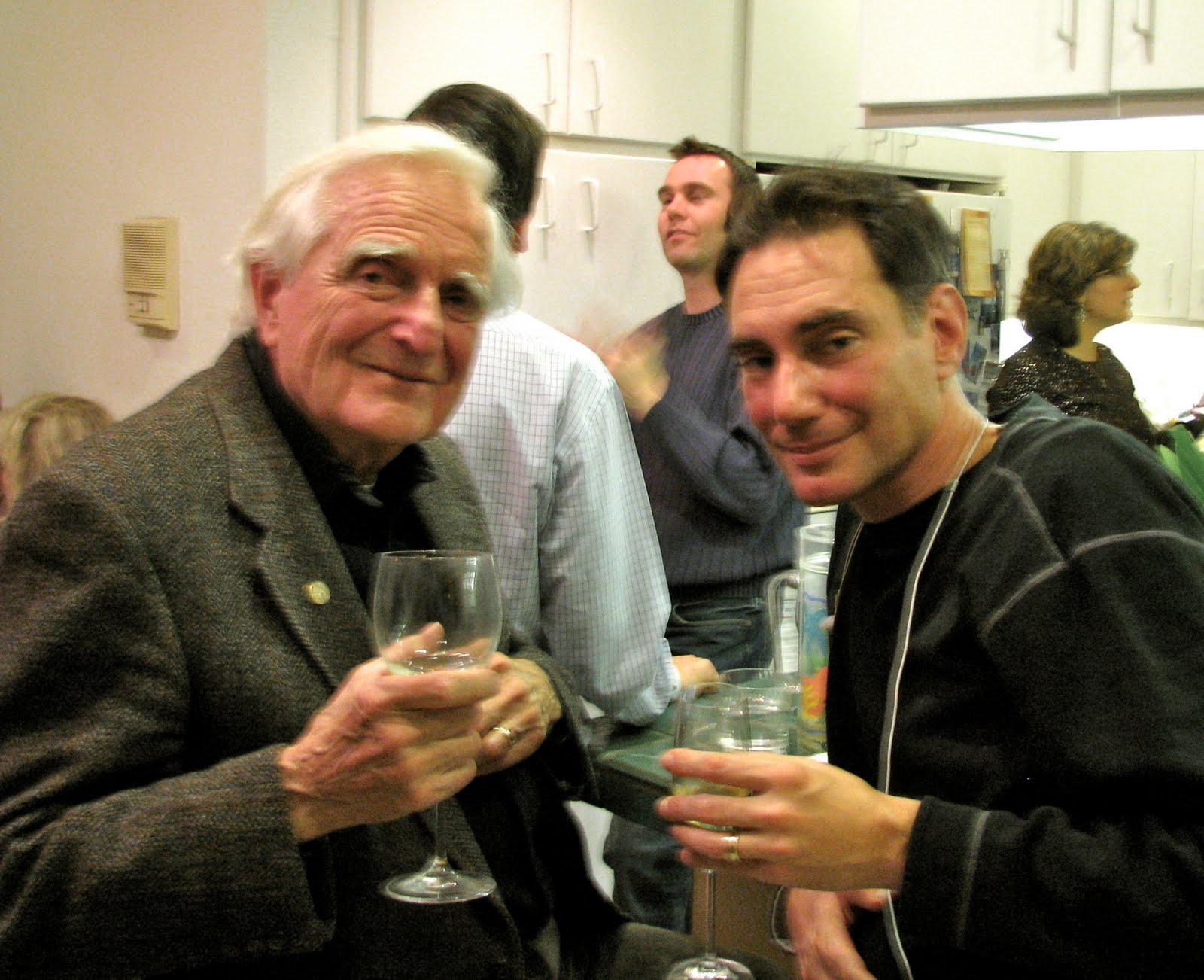
| Doug Engelbart and David Nordfors |
On December 9, world leaders debated global climate in Copenhagen and Obama was in Oslo to accept his Nobel. I was sharing a glass of wine with Doug Engelbart, father of personal computing as we know it, in the kitchen of Mei Lin Fung, Doug's long-time friend, in Palo Alto. It was a potluck dinner, shoes off, sparing Mei Lin's floors. I sensed links. Half a world away, people were commemorating the world's biggest problems, preparing for gala dinners, while we toasted the birth of perhaps the most powerful tool in human hands, sitting in that cozy kitchen among people who had made it happen.
Doug was guest of honor. In San Francisco, on Dec 9 1968, his 'Mother of All Demos' gave birth to the modern PC: Doug and his SRI team, with chief engineer Bill English, demo'ed for the first time personal computing as we recognize it today, showing the first computer mouse, interactive text, video conferencing, teleconferencing, email, hypertext and a collaborative real-time editor.
![]() |
| Mei Lin Fung |
When groups face common problems, power goes to those who must agree for anything to happen. Often their political power and the value of their 'OK' grows as they hold out--supply and demand. If the problem is bad and people want their 'OK' they say 'Well, first YOU must [insert demads here].' They may be conscientious, backed by their constituencies, so it might not seem immoral. Leaders build power, stature and wealth for their followers by gatekeeping. Some may get a Nobel, others may end up in the International Criminal Court in the Hague. The need for consensus breeds gatekeeping. That's the game.

Back to Mei Lin's kitchen. It might be closer to the solution than banquet halls in world capitals. The name 'Mother of All Demos' came later. The actual name marking the birth of real personal computing was 'a research center for augmenting human intellect.' Doug's idea was not to make computers smarter, it was to help people be smarter. Computers had been about automation, replacing but not augmenting intellect. Doug was lucky, a chosen researcher supported by J.C.R. 'Lick' Licklider at ARPA, the visionary accredited for planting the seeds of computing in the digital age. Normal funders disdained people like Doug: the ideas did not fit their funding.
Lick coined the "intergalactic computer network," a vision of computers collaborating. The Internet protocol that enabled it was invented by Vint Cerf and Bob Kahn. Vint - often referred to as 'father of the Internet' - is today at Google, still reforming civilization.
Doug hosted the second node of the Arpanet, the predecessor of the Internet, at his SRI center, believing that by networking PCs humanity could improve its 'collective intelligence' and solve tougher problems: such as avoid nuclear wars, stop pandemics and solve environmental issues. Solutions via traditional multilateral agreements may be hard: they engender gatekeeping, brinkmanship and cheating on agreements.
But through improved PCs and the Internet, it is easier to innovate, to introduce game-changing novelties, that can bypass obstacles to getting things done. If gatekeepers disagree, innovate and re-design the game to work without them.
![]() |
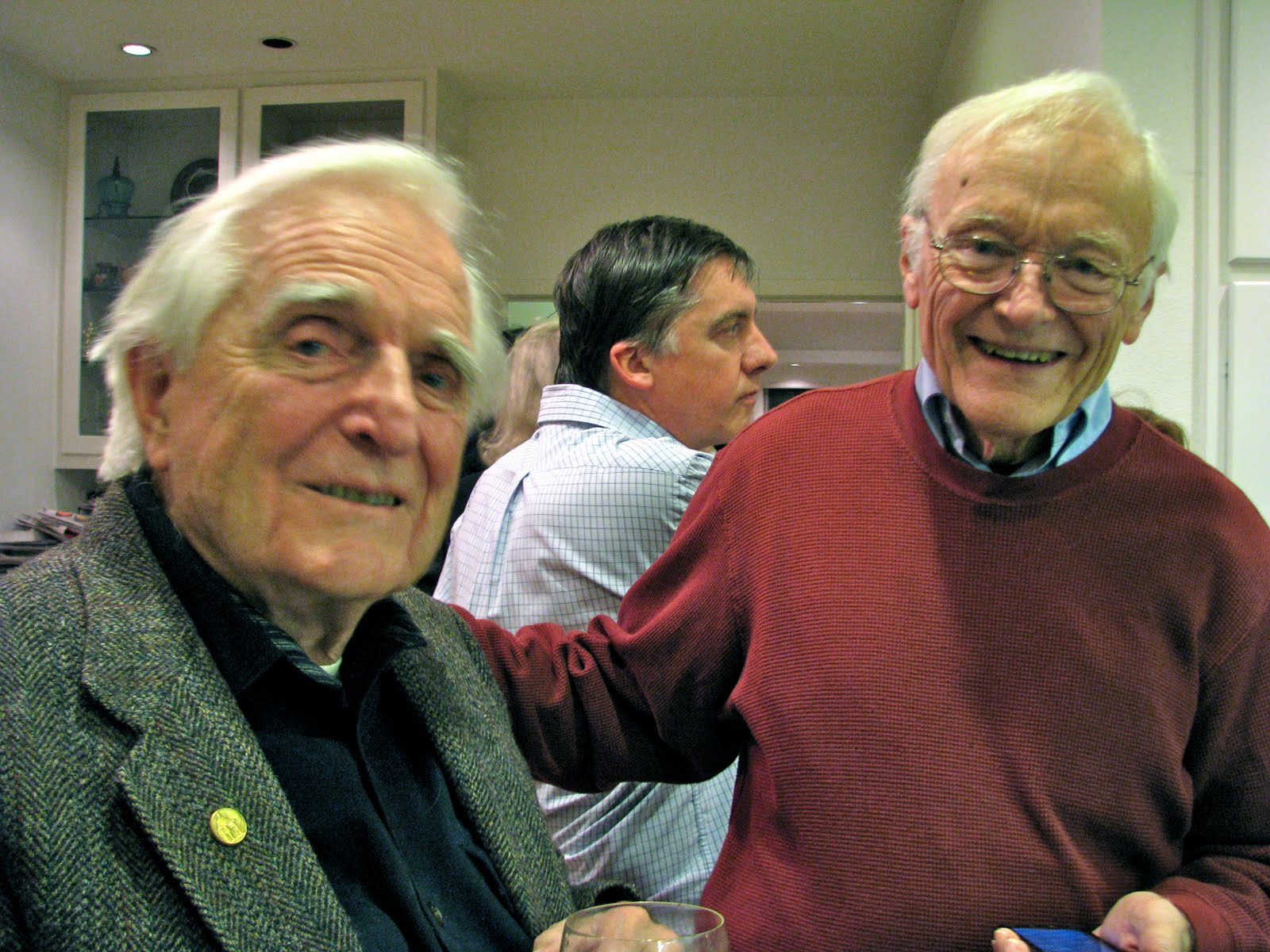
| Doug Engelbart and Bill English Bill is holding the Google Phone |
Voices--including Thomas Friedman's--are saying that innovation, not multilateral regulation, should drive the climate issue. The ideal: a balance between innovation and regulation. Necessary international agreements can be driven by the innovation ecosystem, putting gatekeepers at risk of being bypassed. And international agreements can enable the innovation ecosystem, through creating incentives.
![]() |
| David Nordfors |
PS. The achievement of 'the Mother of All Demos' was astonishing. Mei Lin: "That demo was never supposed to work." It might not have if not for Bill English. Bill was there, showing his new cell phone. Later it became known that Google had given beta versions of its own Android to selected people (Bill probably among them). Did anyone in Oslo or Copenhagen get one?
Friday, December 11, 2009
Slovenian InJo-InCo 2009 Manifesto

Violeta Bulc's Vibacom have released the InJo-InCo 2009 Manifesto, the project is lead by Estera Lah P0ljak. The publication is in Slovenian, there is a summary in English here. It starts like this:
"Identifying significant events and projects, becoming aware of their importance in time and space, critically assessing their advantages and challenges, capturing responses of different stakeholders, proposing initiatives and future activities. These were our guidelines in drafting
the second issue of our annual publication, the InJo-InCo Manifesto 2009. All of the above is also included in the principles of innovation journalism, from which the InCo movement as a business-civil initiative was initiated and grew into wider innovation communication projects interconnecting different stakeholders of the innovation space based on dialogue. This publication is a result of this active involvement. The title “Manifesto” itself demands action or manifestation, thus we start by proposing initiatives for an innovative breakthrough of Slovenia drafted based on the philosophy, dialogue and experiences of the InCo movement in the field of innovation communication and journalism in 2009. These initiatives are accompanied by commitments the InCo movement will fulfil in 2010 and which we believe will raise awareness about creativity and innovation in Slovenian space."
PBS Mediashift InJo Feature
Stanford Program Breaks Down Walls Between Business, Tech Journalism
by Mark Glaser, December 10, 2009
Tagged: david nordfors, innovation, innovation journalism, stanford university
I am so used to hearing about innovation in journalism that when I first heard about theInnovation Journalism program at Stanford, I assumed that's what it focused on. Not exactly.
The VINNOVA-Stanford Research Center of Innovation Journalism actually focused on helping journalists cover the field of innovation. David Nordfors, a Swedish punk rocker-turned-molecular-physicist-turned-journalist, found that journalists were stuck in silos of "business journalism" and "technology journalism" and couldn't see the big picture of innovation.
In 2003, Nordfors started the Innovation Journalism program, bringing mid-career journalists from around the world to Stanford University as fellows. They were placed in San Francisco Bay Area newsrooms to learn the new ways that reporters and bloggers were covering technology and innovation. Those newsrooms include the Wall Street Journal, San Francisco Chronicle, CNET and even the Technologizer blog. There's also an annual Conference on Innovation Journalism at Stanford, where the fellows present their work and discuss related topics.
While the program was set up to help journalists do a better job of covering the topic of innovation, there is now a need for journalists to do a better job of covering innovation in journalism itself. Nordfors told me that journalists charged with covering the media are good practitioners of innovation journalism, because they are mixing business, technology, lifestyle and political journalism in one beat. He stresses that journalists need to break out of their silos and go across disciplines for better coverage of innovation.
I recently sat down with Nordfors at Stanford to talk about the Innovation Journalism program, and get his take on the current state of journalism, and how media companies -- and even journalism schools -- need to change. The following is an edited transcript of our conversation, including audio and video clips.
[ read the rest of it on PBS Mediashift / David.]
Sunday, December 06, 2009
Journalism Needs a Business Model for the Truth

(This story is also published through the Huffington Post)
Journalism's first obligation is to the truth. Discussions about Truth and Objectivity in journalism often become questions of journalistic ethics and the trustworthiness of individuals and brands. These are good things but increasingly inadequate in backing up a story.
Convincing people the news is true by saying "because I told you so" is not working as well as it used to. The Internet is making it harder. Today people can read almost any news publication on the Internet, or check the sources of journalistic stories.
Some trusted news brands and individuals have experienced major scandals in recent years. The New York Times suffered from the fake star journalist Jayson Blair. Iconic anchor Dan Rathers of CBS’ high-profile investigative journalism show "60 Minutes" tripped with the fabricated Killian documents, and was brought down by blogger Charles Johnson.
How can professional journalism maintain its reputation for truth and objectivity?
The truth is often elusive. Events can have many explanations. Other circumstances are not what they seem. What we believe to be true today may be in doubt tomorrow. And then, of course, there has to be a news angle.
Physicists deal with the truth as closely as anyone can come to it. In science, models that can't predict are discarded and non-repeatable experiments dismissed. When scientific researchers write an article, the reader must always be given enough information to be able to repeat the observation. Otherwise the article should not be published.
Journalistic stories are much less accountable. A journalistic story rarely supplies readers with knowledge and references that lets the readers confirm the story. Links to information sources central for the story, even public ones readily available on the Internet, are omitted. Especially old-style journalism does not use links and references, bloggers do, much more.
Journalists and news outlets committed to the truth can make it into policy to link to important sources, and to write the news stories such that audiences can see how sources and assumptions were used to build the story. If readers reconstruct the story this way, they can add their own research. They can discuss the value of the sources, suggest other sources that were omitted, etc.
Traditional news organizations have never let that happen, because links lead readers away from their site. In their ‘attention’ business model – attracting eyeballs to pages and selling them to advertisers - the site needs to be sticky. Instead, the blogosphere is leading the way in developing the culture of linking to sources, because it depends less on ads.
Unfortunately, professional journalism has deeply rooted traditions. I was invited recently to a conference with the World Economic Forum, where we discussed the role of journalism in society. When I suggested that journalism should link to sources, a world-leading news organization chief commented that they wanted to do it and had tried, but their business did not allow it. For many journalists, that ends the discussion. But this is not where the discussion ends. Instead, it is where the discussion begins. We need to ask: "What are the business models for the principles of journalism?"
Societies that care about improving their collective ability to make priorities and informed decisions, need business models that promote journalists to link to sources, so that both readers and other journalists can check the stories and use them for continued research.
Some people think professional journalism is finished, that it can be replaced by citizen journalism or social interaction in social networks. I disagree. Professional journalists have an incentive to represent their audience. Who knows which incentives unpaid journalists have, or who they have their mandate from?
Professional journalism is needed as much now as ever before. With the Internet, peoples’ worlds of information are transforming from silent rural isolation to the bustling cacophonies of the metropolitan street. Journalists who focus public attention on issues that interest the public, working in the interest of and with the mandate of their audiences will be powerful. They will focus public discussion enabling people to improve society. The key for that is in the business model – journalists need the right incentives.